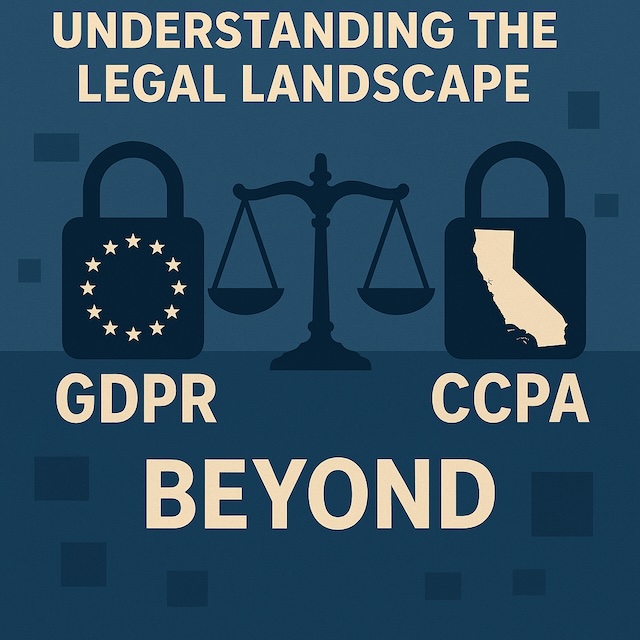
The Global Web Meets Local Laws
We earn commissions when you shop through the links below.
eCommerce knows no borders — your online store might be registered in the U.S., hosted in Europe, and selling to customers in Asia. But when it comes to data privacy, location matters.
Even if you’re not based in a certain country, the laws of your customer’s region can still apply to you. That’s why understanding the privacy frameworks shaping global eCommerce is no longer optional — it’s essential.
Let’s break down the most influential regulations, what they require, and how they impact your online business.
GDPR: The Gold Standard of Data Protection
Full Name: General Data Protection Regulation (EU 2016/679)
Applies To: Any business processing data of individuals located in the European Union (regardless of company location).
Key Principles:
- Lawfulness, fairness, and transparency — You must clearly explain how and why you collect personal data.
- Purpose limitation — Data can only be used for the specific reason it was collected.
- Data minimization — Collect only what you truly need.
- Accuracy — Keep information up to date.
- Storage limitation — Don’t keep data longer than necessary.
- Integrity and confidentiality — Protect data with adequate security measures.
Rights of EU Customers:
- Access: Customers can request copies of their personal data.
- Correction & Deletion: “Right to be forgotten.”
- Portability: Customers can move their data to another provider.
- Objection: They can refuse processing for marketing or profiling.
Penalties:
Up to €20 million or 4% of global annual turnover, whichever is higher.
CCPA & CPRA: California’s Consumer Privacy Framework
Full Name: California Consumer Privacy Act (2018), amended by the California Privacy Rights Act (2023).
Applies To: Businesses that serve California residents and meet certain thresholds (e.g., revenue, data volume).
Key Features:
- Right to know what personal data is collected and shared.
- Right to delete personal data.
- Right to opt out of the sale or sharing of data.
- Right to non-discrimination for exercising privacy rights.
CPRA Updates:
- Introduced the California Privacy Protection Agency (CPPA) to enforce the law.
- Expanded “personal information” to include precise geolocation and sensitive data (like health or race).
- Required stricter data retention and minimization policies.
Penalties:
Up to $7,500 per intentional violation, and even unintentional ones can add up quickly.
PIPEDA: Canada’s Privacy Standard
Full Name: Personal Information Protection and Electronic Documents Act
Applies To: Private-sector organizations operating in Canada.
Key Features:
- Requires meaningful consent for data collection and disclosure.
- Mandates organizations to notify individuals of breaches that pose “a real risk of significant harm.”
- Emphasizes accountability — businesses must have a designated privacy officer.
Notable Difference:
PIPEDA allows implied consent in limited situations (unlike GDPR’s stricter model).
LGPD: Brazil’s Data Protection Law
Full Name: Lei Geral de Proteção de Dados Pessoais
Applies To: Companies processing data of individuals in Brazil.
Highlights:
Enforced by the ANPD (National Data Protection Authority).
Closely modeled after GDPR.
Establishes ten legal bases for processing data.
Gives individuals rights to access, correct, and delete their data.
PDPA: Singapore’s Pragmatic Privacy Approach
Full Name: Personal Data Protection Act (PDPA)
Applies To: Organizations collecting, using, or disclosing personal data in Singapore.
Features:
- Focuses on consent-based collection and reasonable use.
- Requires businesses to appoint a Data Protection Officer (DPO).
- Allows cross-border data transfers if comparable protection standards are met.
Other Emerging Laws to Watch
U.S. States: Beyond California, states like Colorado, Virginia, and Utah have passed their own privacy acts.
India: Digital Personal Data Protection Act (DPDP 2023) introduces consent-based rules similar to GDPR.
UAE & Saudi Arabia: Establishing national frameworks for data sovereignty.
What This Means for Your Online Store
If you sell internationally, your compliance needs to go beyond your local law. That means:
- Implementing a global privacy policy that reflects multiple jurisdictions.
- Using a consent management platform to handle regional cookie and consent rules.
- Documenting your data flows to know where customer data resides.
- Training your team to respond to data access and deletion requests.
Compliance may seem complex, but it’s the foundation of long-term customer trust.
Coming Next:
Part 3 — How Data Travels in eCommerce: Mapping the Data Lifecycle
We’ll explore how customer data moves through your systems — from checkout to CRM — and how to make every step privacy-compliant.
If you want to read more about Understanding the Legal Landscape — GDPR, CCPA & Beyond, please see Recommended Books.